Seeing Sound: The Rebel Apps Rewiring Human Perception One Frequency at a Time
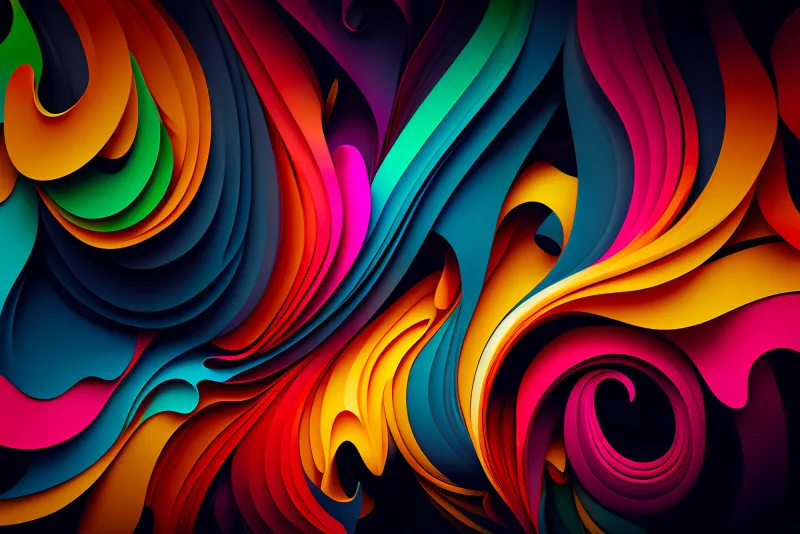
Photo: colorful sound waves abstract light spectrum visualization, via www.creativefabrica.com
Your Senses Were Always a Suggestion
Here's something neuroscientists have known for a while but the rest of us are only just catching up to: your senses don't actually operate in separate lanes. They bleed into each other. They gossip. A sharp enough sound can feel like a color. A particular shade of yellow can taste, to some people, like something faintly acidic. The brain is less a precision instrument and more a wildly improvisational jazz ensemble — and a handful of startups are betting everything that you'd like to hear what happens when someone hands it a new instrument.
Welcome to the emerging world of digital synesthesia apps — platforms deliberately engineered to make your brain experience one sense through the machinery of another. We're not talking visualizers that bounce to your Spotify playlist. We're talking about carefully designed neurotechnology that trains your perception to genuinely blur the boundary between sound and color, between music and texture, between a chord progression and a physical space.
The Science Behind the Scramble
Synesthesia, in its natural form, affects somewhere between 3 and 4 percent of the population. For genuine synesthetes, the experience isn't metaphorical — a C-sharp really does appear as a specific shade of amber. The letter G might feel like velvet. These aren't hallucinations. They're consistent, reliable, cross-wired perceptions baked into how those brains process input.
What the new generation of apps is attempting is something more audacious: inducing a functional version of that cross-modal perception in neurotypical users through repeated, structured stimulus pairing. Think of it like sensory training wheels.
San Francisco-based startup Chromavox launched in late 2023 with exactly this premise. Their app presents users with sustained tones paired with specific color fields — not random, but mapped according to research on how synesthetes themselves consistently experience sound-to-color associations. Over weeks of daily sessions, some users report that the associations begin to stick unprompted. Hear the tone outside the app, see the color ghost across your inner vision.
"We're not manufacturing a hallucination," Chromavox co-founder Priya Anand told us over a call from her Mission District office. "We're revealing a capacity the brain already has. We're just giving it permission."
The App Store Gets Psychedelic
Chromavox isn't alone. The App Store and Google Play have quietly become a strange little neighborhood of perception-bending tools. Resonance Field, built by a two-person team out of Austin, uses binaural audio layered with generative color fields to create what they describe as "immersive synesthetic environments." You put on headphones, you stare into the app's shifting color landscape, and the frequencies are specifically tuned to encourage gamma wave activity — the brainwave pattern associated with heightened sensory integration.
Then there's COLORSOUND, an indie project from Brooklyn developer Marcus Webb, who built the app over two years after reading a study on cross-modal plasticity. His approach is rougher around the edges, more experimental, and honestly more interesting for it. COLORSOUND lets users build their own sound-to-color mappings from scratch, essentially designing their own personal synesthetic language. Webb describes it as "teaching yourself a second native tongue, except the language is pure sensation."
Early adopters have been vocal about their experiences — and the reports are genuinely weird in the best possible way. One user on the COLORSOUND subreddit described listening to a Coltrane record after three weeks of daily sessions and seeing "these deep burgundy shapes just sitting in the room with the music, like furniture." Another described a commute on the NYC subway where the ambient noise of the train took on a flickering, pale green quality she hadn't noticed before.
Are these genuine perceptual shifts? Placebo? A little of both? The honest answer is: neuroscience doesn't fully know yet.
Art Consumption, Rewired
What makes this moment genuinely fascinating from an art and culture angle isn't just the neuroscience — it's what these tools might mean for how we experience creative work.
If you can train your brain to hear a painting, what does that do to how you stand in front of one? If music becomes something you see as well as hear, does that change what a concert means? Several contemporary artists are already leaning hard into these questions.
New York-based sound artist Delara Nouri has started incorporating Chromavox sessions as a pre-show ritual before her live performances, essentially priming her audience's perceptual state before they hear a single note. "I want them arriving already open," she says. "The app does the first layer of work. I do the rest."
Museums are paying attention too. A small but growing number of experimental gallery spaces — including a residency program at a Brooklyn arts collective that asked not to be named — have begun piloting synesthesia apps as part of exhibition design, asking visitors to use them during installation walkthroughs.
Manufactured Experience or Expanded Consciousness?
Not everyone is enthusiastic about where this is heading. Critics — and there are some — worry about the implications of commercially packaging altered perception. When a startup can sell you a new sensory reality, who owns the experience? What happens when the subscription lapses?
There's also the more philosophical concern: if your synesthetic experience was built by an algorithm trained on aggregate data from other users, is it really yours? Or are you just running someone else's perceptual software?
These are real questions. But they're also the exact same questions that get asked every time a new tool for expanding human experience arrives — about psychedelics, about VR, about cinema itself when it first put images in motion.
What feels undeniable is that these apps are pointing toward something. A future where the line between art consumption and perceptual transformation stops being a line at all. Where listening to an album isn't just a passive act but a full-body reconfiguration.
Your senses were always a suggestion. These developers are just finally handing you the pen.