Ghost Flavors and Phantom Textures: Inside the Neuroscience Labs Rewiring What You Think You Feel

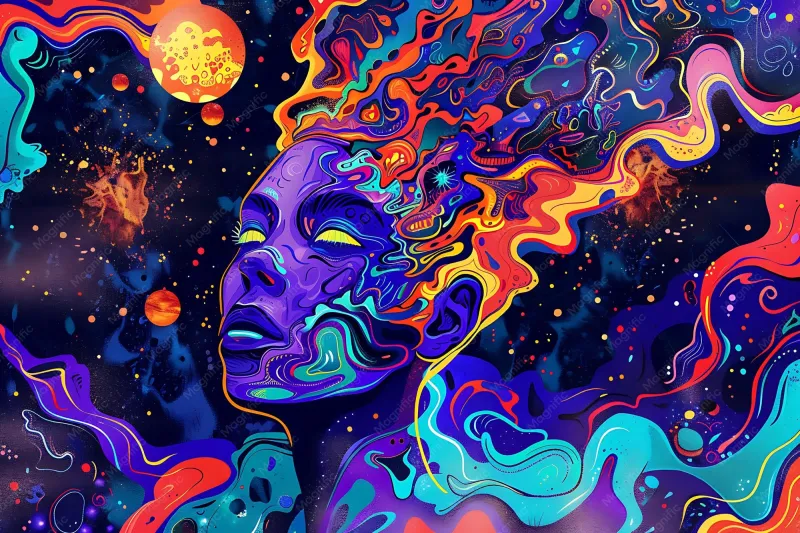
Photo: abstract neuroscience brain sensory waves colorful psychedelic, via i.pinimg.com
Your Senses Are Being Hacked (And You Probably Enjoyed It)
Here's a weird thing to sit with: the last time you cracked open a soda can, the sound may have made it taste better. Not metaphorically. Literally. Researchers at Oxford's Crossmodal Research Laboratory have spent years documenting how a sharp, high-pitched pop primes your brain to perceive carbonation as fresher, more intense — even before a single molecule of liquid hits your tongue. Coca-Cola knows this. So does every other beverage company with a neuroscience budget, which, increasingly, is all of them.
Welcome to the synesthesia economy — a fast-growing corner of consumer culture where brands aren't just designing products, they're engineering perceptions that don't exist in any conventional sensory channel. Sounds that conjure flavors. Packaging surfaces that trigger phantom textures your fingertips never actually encountered. Retail environments calibrated to produce the ghost of a scent that no diffuser is emitting. It's less "marketing" and more "controlled hallucination," and it's already operating at massive scale.
The Science of Crosswired Perception
Synesthesia — the neurological phenomenon where stimulation of one sense automatically triggers another — affects roughly 4% of the population in its clinical form. But here's the thing neuroscientists have been quietly confirming for the past decade: to a lesser degree, we're all synesthetic. Every human brain processes sensory input through a web of cross-modal associations, meaning sounds subtly influence taste, color shapes smell perception, and texture primes emotional response.
"The borders between our senses are far more porous than most people realize," says Dr. Renata Voss, a cognitive neuroscientist who consults for consumer brands on sensory design. "What we experience as a unified reality is actually a construction — an edit. Once you understand that, you realize how much room there is to intervene in that editing process."
Brands intervening in that editing process is not new — Muzak has been manipulating shopping behavior through ambient sound since the 1930s. But what's changed is the precision. Modern neuromarketing firms use fMRI data, galvanic skin response testing, and AI-driven sensory modeling to identify exactly which stimuli trigger which phantom perceptions in which demographic segments. The result is a kind of sensory surgery — targeted, personalized, and operating largely below conscious awareness.
The Texture That Wasn't There
Walk into a Glossier flagship store and pay attention to what your hands are doing. The brand's packaging — that distinctive millennial-pink foam pouch — has been engineered not just to look soft but to feel softer than it physically is. The matte finish, the slight resistance of the material, the weight distribution: all of it is calibrated to trigger what product designers call a "phantom plush" response, a tactile sensation your brain generates in anticipation of an experience the packaging only partially delivers.
This isn't accidental. Glossier has spoken openly about investing in "emotional packaging design." What they're less vocal about is that emotional design, at its cutting edge, is indistinguishable from sensory illusion.
Luxury automotive brands have taken this further. Several high-end car manufacturers now engineer the sound of a door closing — not to reflect the door's actual acoustic properties, but to produce a specific "thud" frequency associated in consumer research with the phantom sensation of weight and solidity. You hear the door close and your body registers a feeling of substance that the door's actual mass didn't generate. You feel safe. You feel expensive. You feel something that wasn't quite real.
Sonic Seasoning at the Restaurant Table
Chef Heston Blumenthal's Fat Duck restaurant in England became famous — or infamous, depending on your appetite for conceptual gastronomy — for serving seafood alongside an iPod playing ocean sounds, demonstrably increasing how "oceanic" diners perceived the flavor. That experiment, conducted with Oxford researchers, sparked an entire subculture of "sonic seasoning" that's now filtering into mainstream American dining.
Some Michelin-starred restaurants in New York and LA now employ sound designers alongside executive chefs, composing ambient soundscapes engineered to enhance specific flavor profiles on their menus. Lower frequencies amplify bitterness and earthiness. Higher pitches enhance sweetness and acidity. The music isn't background noise — it's an ingredient.
"I've had guests describe flavors that weren't in the dish," one anonymous culinary director told us. "Not because we tricked them — the flavors were adjacent, latent. The sound just... surfaced them. Like developing a photograph."
Manipulation or New Art Form?
Here's where the vortex gets uncomfortable. Because there's a meaningful difference between an artist using synesthetic principles to create a richer experience and a corporation using those same principles to make you spend more money on something you didn't need.
Dr. Voss draws a careful distinction: "Informed experience versus covert influence. A musician who creates a synesthetic composition is offering you something. A brand that engineers phantom sensations to bypass your rational decision-making is doing something else."
Consumer advocates have begun pushing for what some are calling "sensory transparency" — disclosure requirements for neuromarketing techniques the way nutrition labels disclose ingredients. It's a long shot in the current regulatory environment, but the conversation is gaining traction in academic circles.
Meanwhile, there's a growing community of artists deliberately weaponizing these same techniques in the opposite direction — using synesthetic design to disorient rather than seduce, to make people aware of how constructed their sensory reality actually is. Digital artists like ASMR-sculptor collective Nerve Garden create installations specifically designed to produce phantom sensations and then immediately reveal the mechanism, turning the experience into a kind of perceptual judo.
Living in the Designed Sensation
Maybe the most honest thing to say is this: your sensory reality has always been partly a construction. Your brain has always been filling in gaps, generating phantom perceptions, editing raw data into coherent experience. What the synesthesia economy has done is recognize that gap between stimulus and perception as commercial real estate.
Whether that's dystopian or simply the next evolution of design depends on who's doing it and why. But one thing is certain — the next time you smell something in a store and can't find the source, or taste something in a sip that the ingredients don't explain, or feel a texture that isn't quite there: you're not imagining it. You're experiencing it exactly as intended.