Sensory Sorcery: How Big Brands Are Turning Your Five Senses Into a Checkout Button
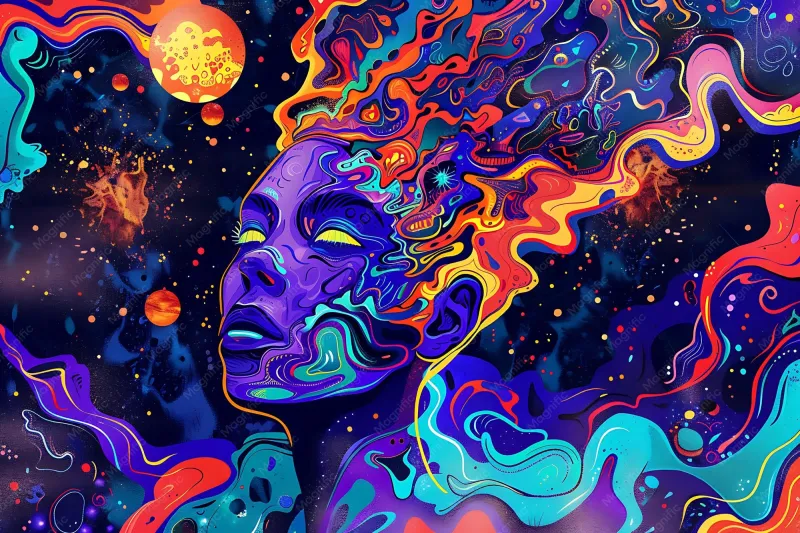
Photo: psychedelic luxury retail store immersive sensory experience neon lights abstract, via img.freepik.com
There's a moment — maybe you've felt it — when you walk into an Apple Store and something happens to your brain before you've even touched a single product. The light is impossibly clean. The air smells like a freshly unwrapped idea. The ambient hum of the space settles into your chest like a minor chord. You didn't come in to buy anything. You leave with a laptop.
That's not coincidence. That's design. Specifically, it's the rapidly expanding universe of synesthetic branding — a discipline that borrows from neuroscience, avant-garde art, and yes, a little bit of sorcery — to collapse the boundary between a product and a feeling. Between a purchase and an experience. Between advertising and, if we're being honest, a mild altered state.
Welcome to the Synesthesia Economy. Population: all of us, whether we signed up or not.
When Sound Becomes a Color Becomes a Craving
Synesthesia, in its clinical form, is a neurological phenomenon where stimulation of one sense involuntarily triggers another — a person might see the number five as inherently red, or hear the note C-sharp as tasting like copper. It's rare, affecting roughly 4% of the population. But brands aren't waiting around for the neurologically gifted. They're engineering artificial versions of this cross-sensory bleed for the other 96%.
Monster Energy is a masterclass in this. Before you crack open that black can, you've already been primed by a decade of aggressive visual grammar — jagged green claw marks, matte black surfaces, the weight of the aluminum in your palm. The sound design of the crack-and-fizz has been studied and iterated. The slight resistance of the pull tab is calibrated. Monster isn't selling a caffeinated beverage. It's selling a physiological state, and the product is just the delivery mechanism.
"The can is a portal," says Marcus Drewe, a sensory branding consultant based out of New York who has worked with beverage and tech clients on what he calls "embodied identity design." "When every touchpoint — visual, sonic, tactile, even olfactory — is tuned to the same emotional frequency, you stop experiencing a brand as external to you. It starts to feel like an extension of your own nervous system."
That's either beautiful or terrifying depending on where you're standing.
Luxury's Invisible Architecture
High fashion figured this out long before the energy drink crowd. Walk into a Chanel boutique in Manhattan and you are not simply shopping. You are being administered. The signature No. 5 fragrance diffused subtly through the HVAC system isn't accidental — it's atmospheric programming. The ivory and black color palette isn't just aesthetic; it's neurologically calibrated to signal restraint, exclusivity, and timelessness simultaneously.
LVMH, the luxury conglomerate behind Louis Vuitton, Dior, and a constellation of other aspirational brands, employs teams of what are essentially sensory architects — specialists who design the full phenomenological experience of entering a retail space. Lighting temperatures are mapped to flatter both the merchandise and the customer's skin tone. Music tempo is adjusted by time of day to modulate browsing pace (slower in the afternoon, when conversion rates are higher).
Dr. Naomi Voss, a cognitive neuroscientist who consults for retail environments, explains that what luxury brands have essentially built is "a controlled sensory deprivation chamber, but in reverse — instead of stripping stimuli, they're layering specifically chosen inputs to suppress critical evaluation and amplify emotional response."
In plain English: they make your prefrontal cortex take a nap while your limbic system gets excited and reaches for your credit card.
Tech Startups Are Going Even Further
If legacy brands are painting with sensory design, some tech startups are operating more like psychedelic muralists. Spatial audio companies like Sennheiser and Dolby are partnering with direct-to-consumer brands to build "sonic identities" — not just jingles, but entire soundscapes that accompany every customer interaction, from unboxing to app notifications to customer service hold music.
Startup Aesthesia Labs (a real player in this emerging space) specializes in what they call "cross-modal brand alignment" — ensuring that a brand's visual palette, sonic signature, textural vocabulary, and scent profile all trigger the same emotional cluster in the brain. Their pitch to clients is essentially: we will make your brand feel like a memory your customer didn't know they had.
The results are measurable. Studies from the Journal of Consumer Psychology consistently show that multisensory congruence — when all sensory elements of a brand experience align — can increase purchase intent by up to 30% and brand recall by significantly more.
Art or Manipulation? The Line Gets Blurry
Here's where it gets philosophically uncomfortable, and also where it gets interesting from an artistic standpoint.
The techniques these brands are deploying — color psychology, binaural audio, haptic feedback design, scent memory triggering — are the same tools used by immersive artists, installation designers, and experimental filmmakers to create genuinely transcendent experiences. The difference, arguably, is intent.
When artist Yayoi Kusama fills a room with mirror-reflected infinity dots, she's inviting you to dissolve the boundary between self and universe. When a luxury retailer does something structurally similar with lighting and scent and curated silence, the invitation is to dissolve the boundary between your identity and their brand.
"I don't think the techniques are inherently exploitative," says Drewe. "But there's an ethical responsibility to be transparent about what you're doing. When you're engineering an experience that bypasses rational decision-making, you're operating in morally complex territory."
Some brands are leaning into the art angle explicitly. Nike's House of Innovation stores in NYC and Chicago are designed less like retail spaces and more like interactive installations — complete with immersive digital environments, customization labs that feel like artist studios, and spatial design that rewards wandering and discovery. The commerce is real, but so is the experience.
The Untwisted Question
So where does this leave us, as consumers navigating a world where the line between a brand and a hallucination is getting genuinely hard to locate?
Maybe the most honest answer is: it depends on whether you're in on the trick. The most avant-garde art has always operated by hijacking perception to reveal something true. The most insidious advertising has always operated by hijacking perception to obscure something real — like, say, the price tag.
The Synesthesia Economy isn't going away. If anything, as spatial computing, haptic wearables, and AI-generated sensory environments mature, it's going to get a lot more immersive and a lot harder to opt out of. The question isn't whether brands will keep doing this. The question is whether we'll develop the perceptual literacy to notice when our senses are being played like instruments — and whether, sometimes, we'll decide the music is worth it.