Wearing the Warp: How Fashion Designers Are Stitching Altered States Into Every Seam
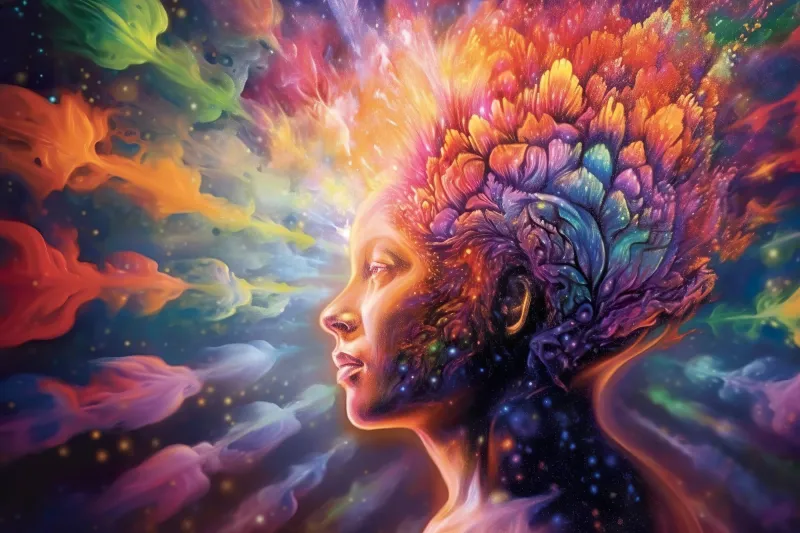
Photo: psychedelic fashion runway colorful abstract patterns model, via scitechdaily.com
The Fabric Is the Trip
There's a moment at a good fashion show — if the designer is doing their job right — where you stop seeing clothes and start seeing something else entirely. Maybe it's a hallway that keeps extending. Maybe it's a color that doesn't have a name. The best designers working in psychedelic aesthetics right now are chasing exactly that feeling, and they're catching it in silk, denim, hand-dyed cotton, and everything in between.
This isn't your uncle's tie-dye revival. The psychedelic renaissance happening across American and global fashion right now is something more deliberate, more philosophical, and frankly, more strange. It's less about nostalgia for Woodstock and more about a generation that grew up on glitch aesthetics, internet surrealism, and — let's be honest — a world that already feels like it's operating on a frequency no one quite tuned in for.
"I'm not trying to reference the sixties," says Brooklyn-based designer Mara Solano, whose 2024 collection Dissolution featured hand-painted gradient coats that seemed to shift color depending on where you stood in the room. "I'm trying to reference the feeling of standing somewhere and not being entirely sure your edges are solid. That's where we all are right now."
Solano is part of a loose but growing cohort of designers — from emerging names in downtown New York to experimental studios in Los Angeles — who are treating garments less like products and more like portals.
From the Runway to the Street Corner
What makes this moment different from psychedelic fashion cycles of the past is how fluidly the aesthetic is moving between high fashion and streetwear. You'll find optical illusion prints on a $4,000 runway piece from a Paris house and the exact same visual energy on a $60 hoodie from an independent label run out of a garage in Portland.
Labels like Cactus Plant Flea Market have been doing this for years — treating garments as canvases for surreal text, distorted imagery, and color combinations that feel slightly wrong in a way that's completely right. But the movement has broadened considerably. Brands like Collina Strada, Heaven by Marc Jacobs, and even mainstream players like Urban Outfitters' more adventurous sub-labels are leaning hard into abstraction, melting geometries, and what you might call "visual anxiety made wearable."
The streetwear angle matters because it democratizes the whole thing. You don't need to attend a runway show or drop a car payment on a single jacket to participate in this particular altered state. The vibe is available, and that accessibility is part of the point.
"Fashion used to gatekeep the weird stuff," says Darius Webb, a Chicago-based stylist who works primarily with musicians and performance artists. "Now the weird stuff is the entry point. Kids are coming to it through TikTok, through music videos, through whatever their algorithm decides they're into. The portal is always open."
Portable Altered States and the Psychology of Pattern
There's actual science lurking beneath the surface of all this. Researchers studying the effects of psychedelics on visual perception have documented something called "form constants" — recurring geometric patterns that appear across cultures and across different psychedelic experiences. Spirals. Tunnels. Lattices. Honeycombs. These aren't random; they appear to be artifacts of how the human visual cortex processes overwhelming stimulation.
Look at the work of designers like Chopova Lowena or the textile experiments coming out of programs at RISD and Parsons, and you'll find these same patterns appearing again and again — not because designers are necessarily tripping when they work (though, you know, no judgment), but because these forms tap into something deep in human visual processing. They're inherently destabilizing. They make the eye work. They create a low-level perceptual hum that's genuinely hard to ignore.
"When someone wears one of my pieces, I want them to feel like they're carrying a frequency," says LA-based textile artist and designer Kemi Oduya, whose recent collection leaned heavily into interference patterns — the kind of overlapping geometric fields that seem to vibrate and shift when you stare at them. "The garment is doing something. It's not passive."
That idea — the garment as an active object, as something that participates in reality rather than just covering a body — is central to the whole movement. These aren't just pretty patterns. They're arguments about perception.
Escapism With Intention
It would be easy to read all of this as pure escapism, and there's definitely some of that going on. We live in a heavy news cycle. The world is a lot. If your jacket makes you feel like you briefly stepped into a dimension where the rules are different, that's not nothing.
But the designers working in this space are quick to push back on the idea that what they're doing is avoidance. If anything, they frame it as the opposite — a way of making the strangeness of the present moment visible and wearable rather than pretending it isn't there.
"We're already living in something surreal," Solano says. "The clothes just make it honest."
That framing feels right. The psychedelic aesthetic in contemporary fashion isn't a retreat from reality. It's reality viewed from a slightly different angle — refracted, amplified, turned into something you can zip up and take with you.
Where It Goes From Here
The movement shows no signs of contracting. If anything, as AI-generated imagery becomes more normalized and the visual landscape gets weirder by default, the designers who were already operating in that territory are going to look increasingly prescient.
Expect to see more collaborations between fashion houses and visual artists working in psychedelic or abstract traditions. Expect more textile innovation — printing technologies and dyeing techniques that allow for effects that weren't possible even five years ago. And expect the conversation between high fashion and streetwear to keep blurring, because the kids who grew up wearing the weird stuff aren't going anywhere.
The vortex is untwisting. Dress accordingly.