Beautiful Broken: 7 Glitch Artists Who Are Making Digital Chaos Look Like a Religious Experience
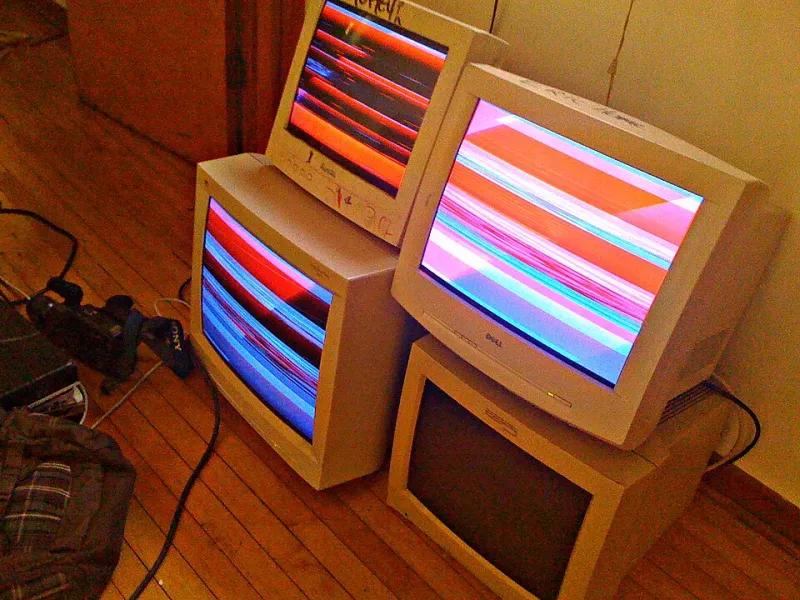
Photo: jonCates, CC BY-SA 4.0, via Wikimedia Commons
When the Machine Fails, the Art Begins
Your laptop freezes. A video file refuses to load correctly and renders a frame of pure chromatic noise. A photograph gets corrupted somewhere between your phone and the cloud and comes back looking like a Rothko painting made by a malfunctioning robot. Most people hit refresh. Glitch artists hit save.
Glitch art is exactly what it sounds like and also nothing like what you'd expect. At its core, it's the deliberate corruption of digital files — images, audio, video — to produce visual or sonic artifacts that the technology was never designed to create. But calling it "deliberate corruption" undersells it considerably. The best glitch artists aren't just breaking stuff and hoping for the best. They're developing deep, technical fluency with the ways digital systems fail, and then using that fluency to make things that are genuinely, inexplicably beautiful.
The movement has been building for decades — you can trace its lineage back to Nam June Paik's video art experiments in the 1960s — but it's hit a particular cultural moment right now. In an era obsessed with perfection (filtered selfies, AI-enhanced images, algorithmic content optimization), glitch art is a loud, pixelated argument for the value of the broken, the unintended, and the strange.
Here are seven artists who are doing it better than almost anyone else.
1. Rosa Menkman — The Theorist of Failure
If glitch art has a philosopher-queen, it's Dutch artist Rosa Menkman. Based in Berlin but widely recognized in US digital art circles, Menkman doesn't just make glitch art — she writes manifestos about it. Her "Glitch Studies Manifesto" is essentially required reading for anyone who wants to understand why breaking things on purpose is a serious artistic practice.
Her visual work matches the intellectual ambition. Menkman's pieces often look like transmission errors from a broadcast that was trying to send something important and got interrupted at the exact right moment. She's interested in what she calls "the perfect imperfect" — the idea that failure has its own grammar, its own logic, its own aesthetic rules.
Technique spotlight: Menkman frequently works with video feedback loops and signal processing errors, feeding output back into input until the system produces artifacts that couldn't be planned or predicted.
2. Takeshi Murata — Where Glitch Meets Cinema
New York-based Takeshi Murata takes glitch into narrative territory, creating video works that feel like movies that have been partially digested by the technology used to play them. His piece Monster Movie — made by databending a DVD of a low-budget horror film — is a landmark of the form: recognizable enough to be unsettling, corrupted enough to be something else entirely.
Murata's work forces you to think about how much of what you see in digital media is actually constructed by compression algorithms and playback systems rather than the original content. Pull the curtain back far enough, and everything digital is just math making decisions. His glitches reveal those decisions going wrong in ways that feel almost confessional.
Technique spotlight: Databending — opening a media file in software that wasn't designed to read it (like opening an image file in a text editor and then saving it) to introduce structured chaos into the data.
3. Sabato Visconti — The Glitch Photographer
Sabato Visconti's Instagram presence alone has introduced glitch aesthetics to hundreds of thousands of people who might never have encountered the movement otherwise. His photographs — which he corrupts using a variety of databending and pixel-sorting techniques — look like portraits taken in a dimension that's slightly out of phase with ours. Faces dissolve into streams of data. Colors bleed across edges that should be fixed. Reality, as Visconti renders it, is always in the process of coming apart.
His work is accessible without being dumbed down, which is part of why it's spread so widely. You don't need to know anything about data structures to feel the emotional impact of a face that's halfway between a photograph and a transmission error.
Technique spotlight: Pixel sorting — using software to reorganize pixels in an image based on their brightness, hue, or saturation values, creating streaking, flowing distortions that follow the logic of the image's own color data.
4. Evan Meaney — Glitch as Grief
Chattanooga-based artist Evan Meaney does something unusual in the glitch art world: he makes work that's explicitly emotional. His ongoing Celadon series uses corrupted video to explore themes of memory, loss, and the unreliability of recorded experience. Watching his pieces, you get the sense that the glitches aren't random failures — they're the visual equivalent of trying to remember something you can't quite hold onto.
Meaney's work is a reminder that glitch art doesn't have to be cold or cerebral. The broken image is also a deeply human image. We are, after all, biological systems that fail in patterned ways too.
Technique spotlight: Hex editing — directly manipulating the raw binary data of a file to introduce errors at precise locations, allowing for more controlled and intentional forms of corruption.
5. Kim Asendorf — The Algorithmic Sorceror
German artist Kim Asendorf is probably best known for creating the pixel sorting algorithm that Sabato Visconti and countless others have used, but his own artistic practice goes considerably further. Asendorf works at the intersection of glitch aesthetics and generative art, writing code that produces images operating by their own internal logic — beautiful, alien, and completely unlike anything a human hand could produce.
His work raises interesting questions about authorship and intention in glitch art. If you write an algorithm that generates glitches, are you the artist or is the algorithm? Asendorf seems content to let that question hang in the air, unresolved.
Technique spotlight: Generative pixel sorting — writing custom algorithms that apply sorting logic dynamically across an image, creating effects that vary based on the specific data of each individual file.
6. Phillip Stearns — Weaving With Corrupted Data
Phillip Stearns does something that sounds like it shouldn't work and then absolutely does: he takes corrupted image data and weaves it into physical textiles. His Glitch Textiles project translates the visual artifacts of corrupted digital files into woven fabric, creating pieces that exist in both the digital and physical worlds simultaneously.
The effect is genuinely disorienting in the best possible way. These are blankets and tapestries that look like screenshots of a system crash, except you can touch them. They're warm. They have weight. The glitch becomes tangible, and that materiality changes everything about how you experience it.
Technique spotlight: Data sonification and translation — converting digital image data into formats that can control physical production systems like CNC looms, bridging the gap between virtual corruption and material form.
7. JODI — The Original Chaos Agents
No list of glitch artists is complete without JODI — the collaborative duo of Joan Heemskerk and Dirk Paesmans, who have been making deliberately broken digital art since the early 1990s. Their websites look like they've been destroyed. Their video games are unplayable in ways that feel intentional and important. Their work predates the term "glitch art" and helped define what the whole movement would become.
JODI's central argument — that the surface of digital technology is a fiction maintained by enormous effort, and that looking at what's underneath is a radical act — remains as relevant today as it was when they first started making work. Maybe more so.
Why This All Matters
Glitch art is having a moment partly because the world it's responding to has gotten more extreme. We live inside digital systems constantly now — working, socializing, perceiving. The pressure to present perfect, optimized, algorithmically appealing versions of everything is relentless.
Glitch art breaks that pressure. It says: here is what the system looks like when it stops performing. Here is what's underneath the interface. And it turns out what's underneath is strange, and unpredictable, and sometimes — if you're willing to look — genuinely gorgeous.
The machine fails. The art begins. Welcome to the vortex.