Buy a Ticket, Lose the Floor: A Field Guide to America's Fever-Dream Attractions
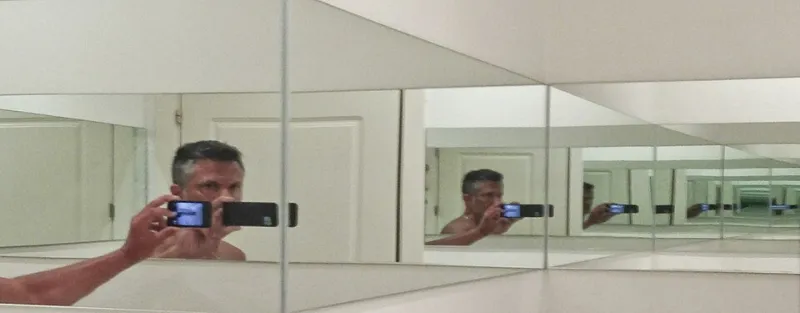
Photo: Pittigrilli, CC BY-SA 4.0, via Wikimedia Commons
Somewhere in Wisconsin Dells, a family of four is currently screaming in a house where water appears to flow uphill. In Manhattan, a tourist is taking her four hundredth photo of a mirror that seems to contain infinite versions of her. And in a converted warehouse in Santa Monica, a man is clinging to a handrail because a tilted room told his body he's falling — and his body believed it.
Welcome to the golden age of the fever-dream attraction: the walk-through illusion you buy a ticket to enter. These aren't haunted houses and they aren't museums. They're perceptual scams, engineered with paint, angles, and light, and business is booming from coast to coast.
Here's a field guide to the best of them — and the science of why you keep falling for it.
The Upside-Down House (Everywhere, But Start in Wisconsin Dells)
The granddaddy of the genre. Entire buildings flipped on their roofs, furniture bolted to the ceiling, you — the only correctly oriented object — standing inside a world that has decided gravity goes the other way.
The trick: It's mostly photography math. Your brain anchors orientation to the room, not to the horizon. Stand on the actual floor, and in every photo you'll appear to hang from the ceiling. The house is a camera prop disguised as architecture.
Why your brain buys it: Vision dominates balance. When your eyes say "up is that way," your vestibular system grumbles but eventually files a minority report nobody reads.
The Infinite Mirror Maze (New York, Las Vegas)
Rooms lined floor-to-ceiling in parallel mirrors, dotted with light tunnels and false doorways. Walk in and the room replicates you into a grid that recedes past the point where your eyes can count.
The trick: Two facing mirrors create infinite reflections; add mirrors at angles and light strips, and the space visually quadruples. Designers place real obstacles — glass panels, dark zones — to keep you from walking into your own reflections.
Why your brain buys it: Depth perception evolved for a world without mirrors. Given contradictory depth cues, your visual cortex picks the simplest interpretation, and "the room is enormous" is simpler than "the room is lying."
The Tilted Room (Museums and Science Centers Nationwide)
A room built at a steep angle — often 20 degrees or more — furnished to look perfectly normal relative to its own skewed walls. Stand inside and watch your friends appear to grow and shrink as they cross the space.
The trick: This is the Ames room principle, named for the ophthalmologist who perfected it in the 1940s. Your brain assumes rooms are rectangular. When they aren't, it warps your perception of the people inside them instead.
Why your brain buys it: Rectangular rooms are so statistically universal that your brain treats "this room is normal, the humans are wrong" as the more plausible explanation. Your brain would rather accuse your family of shape-shifting than admit the architecture is crooked.
The Vortex Tunnel (Science Museums, Boardwalks, and a Few Very Brave Malls)
A short footbridge through a rotating cylinder of lights and stripes. The bridge does not move. You will be absolutely certain it does.
The trick: The ultimate vection machine. Your visual field rotates; your vestibular system reports that your feet are planted. The brain resolves the conflict by concluding the bridge is spinning — and your body starts correcting for a rotation that isn't happening, which is why nearly everyone grabs the rail.
Why your brain buys it: For millions of years, when your whole visual world spun, it meant you were spinning. The tunnel exploits a heuristic that has never once, until now, been wrong.
The Room-Scale Illusion Parks (St. Louis, Myrtle Beach, and Beyond)
The newest generation of attractions bundles a dozen of these deceptions into a single ticket: rooms where one twin appears giant, corridors that seem to stretch as you walk them, floors that look like bottomless shafts thanks to nothing but paint and a well-placed ledge.
The trick: Everything above, combined. These parks are essentially perceptual research labs with gift shops — and honestly, the gift shop is part of the experiment, because after an hour of deceived eyes, a coffee mug looks suspicious too.
Why We Keep Paying
Here's the thing: you could read about the Ames room online in thirty seconds. The illusion survives full disclosure. Knowing the trick doesn't turn it off, because the deception doesn't happen in the thinking part of your brain — it happens downstream, in the machinery that builds your sense of before and behind, up and down.
That's the real product being sold at the ticket window. Not a photo op, though you'll take photos. Not exercise, though you'll get your steps in. What you're buying is the rare, delicious experience of watching your own mind get fooled and knowing it as it happens — the closest most of us come to seeing the wiring behind the wall.
Plan a weekend around one. Bring someone who insists they won't be fooled. Watch them grab the rail in the vortex tunnel anyway.
They always grab the rail.