Rooms That Never Were: The Artists Rebuilding Your Childhood From Scratch
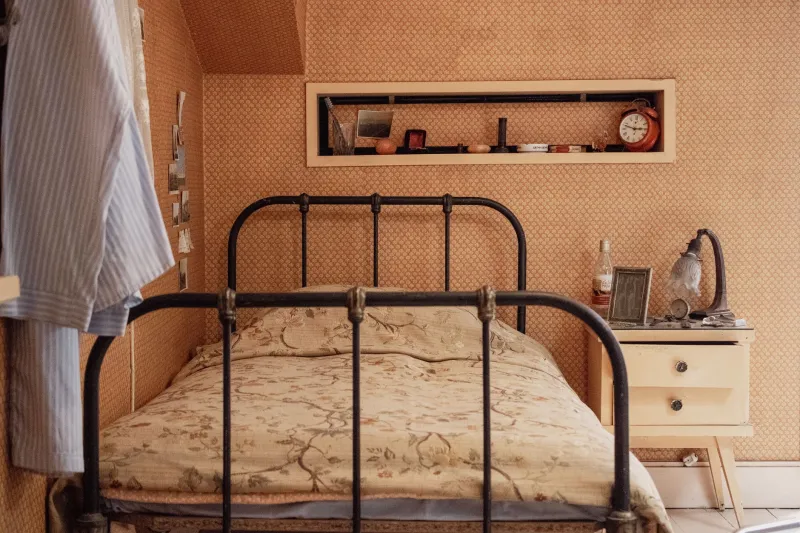
There's a room at the back of a warehouse in East Nashville that smells like someone else's grandmother. Crayon-yellow walls. A chenille bedspread in a shade of mauve that hasn't existed in any Target since 1994. A plastic clock on the wall ticking with that specific hollow sound — you know the one. And here's the thing: none of it is yours. But your body doesn't seem to know that.
This is the work of Mira Solano, a New Mexico-born installation artist who has spent the last four years building rooms that belong to no one and everyone simultaneously. Her project, Borrowed Interiors, reconstructs generic American childhood spaces with forensic precision — not to recreate a specific person's past, but to trigger the sensation of remembering one. The goal is deliberate disorientation. She wants you to feel homesick for a house you never lived in.
"Memory is collaborative," Solano says, sitting cross-legged on the floor of her studio surrounded by fabric swatches and paint chips sorted by decade. "We think our memories are personal archives, but they're more like shared hallucinations. I'm just leaning into that."
The Architecture of False Recall
Solano isn't alone in this project. Across the country, a loose network of experiential artists is building what might be called the false nostalgia movement — installations engineered to exploit the brain's tendency to fill in gaps with borrowed emotional data. These aren't just aesthetically retro spaces. They're sensory traps.
Artist collective Drift & Remain out of Portland uses olfactory design as their primary weapon. For their 2023 piece What the Attic Kept, they hired a fragrance chemist to reverse-engineer the scent of aging cardboard boxes, mothballs, and old paperback glue — the smell of a specific kind of American storage space. Visitors entered a room that was otherwise mostly empty. Just the smell and a single bare bulb. The response was overwhelming. People cried. People laughed. People stood in silence for ten minutes trying to figure out which house they were remembering.
"We weren't trying to manipulate anyone," says collective member Theo Park. "We were trying to prove a point about how thin the line is between your memory and a suggestion."
That point has neuroscientific backing. Dr. Lena Vasquez, a cognitive psychologist at UC San Diego who studies false memory formation, has been quietly collaborating with several of these artists — attending installations, collecting self-reported data, and running follow-up interviews weeks later.
"What we're seeing," Vasquez explains, "is that immersive sensory environments can actually alter how people describe their own autobiographical memories afterward. Not in a dramatic way. But people will say things like, 'I forgot about that smell until I was in there.' Except they didn't forget it — they're confabulating a connection that the installation suggested to them."
Nostalgia as a Controlled Substance
The ethics here get complicated fast, and the artists know it. There's something inherently manipulative about engineering emotional responses at a neurological level. Solano draws a comparison to advertising — the difference, she argues, is transparency.
"A cereal commercial tries to make you feel warm and safe so you buy cereal," she says. "I'm putting you in a room and explicitly telling you: this is a constructed space designed to trigger false memory. The manipulation is the art. You're invited to watch it happen to yourself."
The self-awareness is part of the experience at most of these installations. Visitors at Borrowed Interiors receive a small card at the entrance explaining the project's intent. And yet — knowing doesn't seem to help. The body responds anyway. The throat tightens. The shoulders drop. Something in the brainstem doesn't read the fine print.
Drift & Remain takes a slightly different approach. Their installations offer no explanation at entry — the context comes only after, in a zine available at the exit. Park calls this "emotional lag." "We want you to feel it before you understand it," he says. "Because that's how real memory works. You feel it first. The story comes later."
When Reconstruction Rewrites the Original
The most unsettling implication of this work isn't that it creates false memories — it's what it does to the real ones. Vasquez's research suggests that visiting a highly evocative reconstructed space can actually introduce interference into genuine autobiographical recall. Your brain, essentially, gets confused about which version of the room is the one you actually lived in.
"It's not permanent," she's careful to note. "But in the short term — days, sometimes weeks — people do show evidence of memory blending. They'll describe details from the installation as if they were part of their actual childhood. It's fascinating and, yes, a little concerning."
Solano finds this consequence more interesting than troubling. She points out that memory has never been a reliable recording device. "Every time you remember something, you're reconstructing it," she says. "You're not playing a tape. You're building the room again from scratch, and you get some things wrong every time. I'm just making that process visible."
The Room You'll Never Shake
There's a third room in Borrowed Interiors that Solano won't describe in interviews. She'll only say that it's based on aggregate data — surveys she collected from hundreds of Americans about the specific sensory details they associate most strongly with early childhood. The room is built from statistical consensus. It is, in a weird way, the most American bedroom that has ever existed, assembled from the overlapping memories of strangers.
Visitors come out of it quieter than they went in. Some don't come out for a while.
"I'm not trying to replace anyone's past," Solano says. "I'm trying to show them how the past is already a little bit replaced every time they reach for it. I just made the replacement really, really good."
The installation runs through spring. Bring tissues. Or don't. You probably won't expect to need them anyway.