Gone Walls: The Installation Artists Erasing the Room Until All That's Left Is You
Somewhere in a repurposed warehouse in Detroit, a woman named Sable Orin is standing inside a room she built — and she genuinely cannot tell where her body ends and the space begins. This isn't a metaphor. She built it that way on purpose.
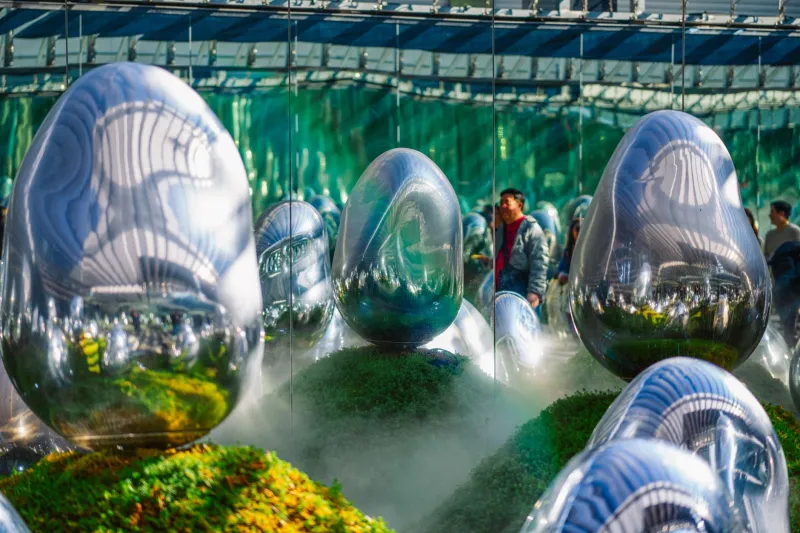
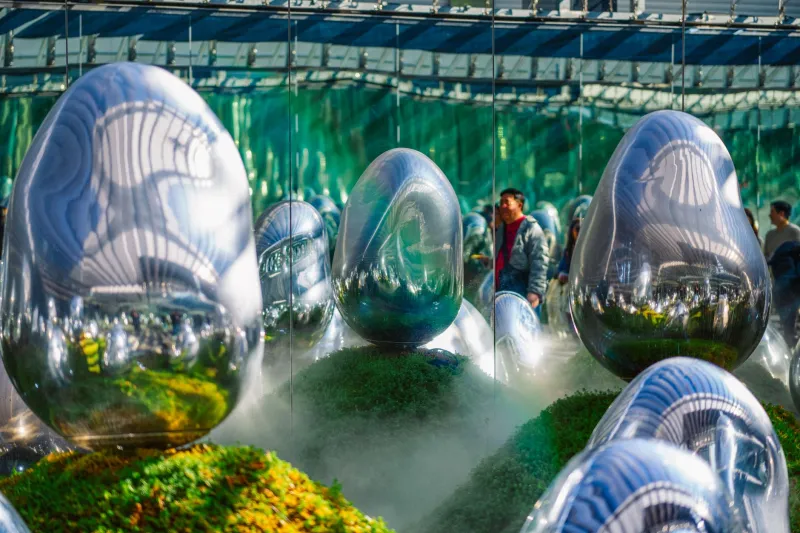
"The goal was never to make something beautiful," she says, turning slowly in a corridor lined floor-to-ceiling with mirrored panels set at angles no interior designer would sanction. "The goal was to make you stop trusting your own coordinates."
Welcome to the world of what's being loosely called reverse architecture — a practice that flips the traditional logic of spatial design on its head. Where conventional architecture works to orient you, to make you feel held and located inside a structure, these artists are doing the opposite. They're building rooms engineered to dissolve your sense of being a body inside a box.
The Room Is the Medium
The movement doesn't have an official name, which is probably by design. The artists working in this space — pun fully intended — tend to resist branding. What they share is a commitment to using scale, light, acoustic texture, and perspective distortion not as aesthetic tools but as cognitive ones. They're not decorating space. They're hacking it.
Take Juno Farraday, a Chicago-based installation artist whose recent piece Soft Periphery filled an entire floor of a former meatpacking facility with layers of translucent scrim hung at varying heights and densities. Visitors walked through it — or tried to. The scrims, lit from above with shifting frequencies of warm and cool light, created a visual field so ambiguous that people kept stopping, unsure whether they were moving toward or away from the center of the room.
"There is no center," Farraday told us. "That's the entire piece. The disorientation is the art. The moment you stop looking for an anchor is the moment the room starts working."
That moment — the surrender — is what these artists are chasing. It's less about what you see and more about what your brain does when it runs out of reliable data.
Scale as a Scalpel
One of the most consistent tools in the reverse architect's kit is scale manipulation. Not just making things big, but making size itself feel unstable.
Marcos Veil, a Los Angeles-based spatial designer who splits his time between gallery installations and immersive theater sets, describes his process as "lying to the eye at the architectural level." His signature move involves building rooms where the ceiling height changes imperceptibly as you move through them — dropping half an inch every few feet, or rising in a way that only registers subconsciously.
"Your brain is constantly modeling the space around you," he explains. "It's doing it automatically, without your permission. What I'm doing is feeding it slightly wrong information, consistently, until the model breaks down. And when it breaks down, something interesting happens — people get very present. Very here. Paradoxically, messing with their sense of location makes them hyper-aware of being located."
That paradox shows up again and again in conversations with these artists. Disorientation, done right, doesn't produce panic. It produces a strange, clarified alertness — the feeling of arriving somewhere you didn't know you were going.
Sound Is a Wall You Can't See
Sensory layering is the other major axis of this work, and sound is where things get genuinely weird.
Brooklyn-based artist collective Null Meridian has been building what they call "acoustic architectures" — spaces where the sound design is so precisely calibrated that it functions as a second set of walls. In their 2023 installation Threshold Mechanics, visitors entered a completely white room with no visible features. The sound design — a constantly shifting blend of low-frequency hum, distant reverb tails, and occasional sharp transients — created the perception of rooms within the room. People reported feeling like they were moving through doorways that didn't exist.
"We're exploiting the fact that your brain uses sound to build spatial maps," says collective member Drea Solano. "It does this automatically. So if you give it spatial audio information that contradicts what the eyes are seeing, you get a conflict. And in that conflict, the room becomes something genuinely new — something that exists only inside the person experiencing it."
This is the philosophical core of the practice: the space is not the installation. You are the installation. Your nervous system, your perceptual assumptions, your habitual ways of organizing sensory input — those are the raw material. The room is just the prompt.
Perceptual Alchemy in Practice
None of these artists would describe what they do as decoration, and most bristle at the word "immersive," which has been strip-mined by brand activations and pop-up experiences selling Instagram moments dressed up as transcendence.
"The word got captured," says Farraday flatly. "Now 'immersive' means a room full of projections of Van Gogh paintings and a gift shop. That's not what we're doing."
What they're doing is closer to what you might call applied phenomenology — using physical materials and spatial relationships to interfere with the ordinary, automatic way consciousness processes being-in-a-place. The goal isn't spectacle. It's a kind of temporary relocation of awareness.
Veil describes it in terms borrowed loosely from perceptual psychology. "There's a thing called the 'default mode' — the background hum of your brain when it's not actively engaged with a task. It's where your sense of self kind of lives. What we're doing, when the work is successful, is interrupting that. The space gets weird enough that your brain has to actually look at where it is. And for a lot of people, that's a genuinely unfamiliar experience."
Where This Is Going
The practice is gaining traction in unexpected places. Museums are commissioning these artists not just for gallery shows but for permanent architectural interventions. Corporate clients — tech companies, mostly — are hiring spatial designers to build offices where the geometry itself is meant to push workers into different cognitive states.
That last development makes some of the artists nervous. There's a meaningful difference between art that dislocates your sense of self in service of expanded awareness, and a workplace designed to make you forget you're being surveilled by manipulating your spatial cognition. The line between perceptual alchemy and perceptual manipulation is real, and it's worth watching.
But for now, in the warehouses and galleries and repurposed industrial spaces where this work is actually happening, something genuinely strange and genuinely interesting is going on. Rooms are being built that eat their own walls. Spaces are being designed to make the concept of "inside" feel optional.
You walk in. You stop knowing where you are. And somehow, for reasons your brain can't quite explain, that feels like exactly where you needed to be.