Floor Is a Suggestion: The Rogue Designers Building Rooms That Break Your Brain's Operating System
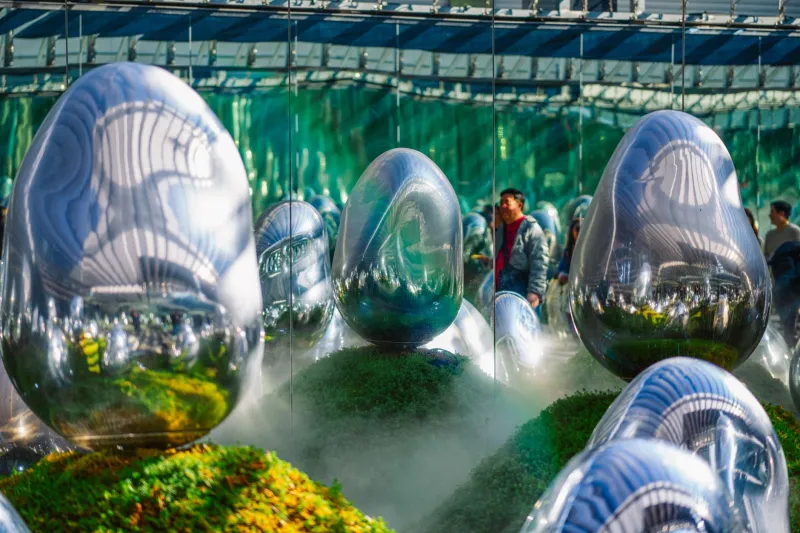
You walk in. You take three steps. And then something — you can't quite name it — goes wrong. Not dangerously wrong. Not fun-house-mirror wrong. Just... fundamentally, quietly, cosmically wrong. The floor is where you left it, but your body isn't sure it agrees. The ceiling looks closer than it did a second ago. You turn around to check the door and the door seems to have moved sideways.
Welcome to the backwards room. Population: your untethered sense of self.
A loosely connected movement of experimental architects, immersive installation artists, and spatial designers is quietly building environments across the US — and globally — that are engineered from the studs up to disorient. Not as a prank. Not as a gimmick. As an art form. As a philosophical statement. As, some of them will tell you with a completely straight face, a form of therapy.
Why Your Brain Hates These Places (and Can't Stop Entering Them)
Here's the thing your nervous system doesn't advertise: it is lying to you constantly. Your brain doesn't actually see the world — it constructs a best-guess simulation based on sensory data, prior experience, and a whole lot of confident assumption. Gravity pulls down. Floors are flat. Parallel lines don't converge until they're very, very far away.
The artists working in this space — and yes, we're using the word space deliberately — know exactly which assumptions to pull out like Jenga blocks.
Take the work coming out of studios like DRIFT, or the spatial experiments embedded in recent installations at places like the Meow Wolf complex in Santa Fe, or the more academic-facing projects emerging from architecture grad programs at SCI-Arc in Los Angeles. The throughline isn't aesthetic. It's neurological. These designers are reading cognitive science papers the way other creatives read Pantone charts.
The technical toolkit is surprisingly low-fi in some cases. Forced perspective — the same trick Renaissance painters used — can make a room feel like it's swallowing you. Angled floors, sometimes tilted only three or four degrees off level, trigger a full-body alarm response your conscious mind can't override. Mirrored surfaces placed at unexpected angles don't just reflect; they multiply, creating spatial recursion that the brain's mapping software genuinely cannot resolve.
Add in controlled lighting — specifically, the removal of shadows — and you've eliminated one of the primary cues humans use to understand depth. The room becomes a floating, dimensionless place. Your proprioception, the internal sense that tells you where your body is in space, starts filing confused reports.
The Time Problem
Here's where it gets stranger. Visitors to these environments don't just get spatially confused — they lose time. Not in a blackout sense. In a where-did-forty-minutes-go sense.
Researchers studying temporal perception have known for a while that our sense of time passing is deeply tied to spatial anchoring. When you move through a familiar environment, your brain is essentially ticking off landmarks: passed the coffee table, passed the lamp, must be about thirty seconds since I sat down. Strip away spatial coherence and you strip away that internal metronome.
Installation artist and architect Numen/For Use — a collective with work that's toured internationally and landed in American venues — builds inflatable tunnel labyrinths out of translucent tape that visitors crawl and float through. People who enter for what they estimate is ten minutes routinely emerge to discover half an hour has evaporated. The absence of fixed reference points doesn't just confuse space. It dissolves time.
Some designers are leaning into this explicitly. There's a growing niche of what you might call temporal installations — rooms designed specifically to induce a mild, consensual dissociation from clock time. The pitch, particularly in wellness-adjacent contexts, is that this is restorative. That the hyperlinked, notification-saturated American brain needs environments where the normal rules simply don't apply, even briefly.
It's a compelling argument. It's also, depending on your tolerance for losing your grip on reality inside an art installation, either deeply appealing or mildly terrifying.
Building the Impossible Room
The construction side of this work is genuinely fascinating. Creating a room that feels physically impossible without actually being physically impossible requires a kind of obsessive precision that borders on the pathological.
Designers working in this mode talk about calibrating disorientation — which sounds like a contradiction but isn't. Too much distortion and visitors just feel sick. Motion sickness, nausea, and a strong desire to leave are the enemy of the experience. The goal is a very specific zone: unmoored enough to be transformative, stable enough to be navigable.
This is where digital modeling tools have changed everything. Using software originally developed for game engine design and VR architecture, these artists can simulate the perceptual effect of a space before a single wall goes up. They're essentially stress-testing human cognition in virtual environments, then building the version that hits the sweet spot between uncanny and unbearable.
The results are spaces that feel like they were built by someone who read the physics textbook and then decided it was more of a loose suggestion. Rooms where the corner you just turned seems to have looped you back to where you started. Corridors that taper in ways that make distance impossible to judge. Ceilings that slope away from you regardless of which direction you're facing.
The Psychological Aftermath
What's perhaps most interesting — and most underreported — is what happens after people leave these spaces.
Anecdotally, and in some preliminary research contexts, visitors report a lingering effect. Not a bad one, typically. More like a recalibration. The ordinary world, for a few hours after, looks slightly different. More constructed. More contingent. The brain, having been forcibly reminded that its spatial model is a model, seems to hold that model a little more loosely.
Some artists are making explicit claims about this. That these environments don't just disorient — they liberate. That experiencing a space where the rules don't hold is a form of cognitive expansion, a brief vacation from the tyranny of assumed reality.
That might sound like a lot of weight to put on a tilted floor and some strategic mirror placement. But then again, the history of art is full of people insisting that a canvas, some pigment, and the right composition could change how you see the world.
Maybe they were just building backwards rooms all along.
Where to Find Your Own Unmooring
If you want to locate your own grip on reality, the Meow Wolf locations — Santa Fe, Denver, Las Vegas, and the newer Grapevine, Texas outpost — remain the most accessible American entry points into this kind of deliberate spatial chaos. teamLab's permanent installation in various international locations, with a foothold growing in the US market, offers a more digitally mediated version of the same fundamental disorientation.
For the more adventurous, keeping an eye on experimental architecture showcases, MFA thesis exhibitions, and the programming at venues like Pioneer Works in Brooklyn or the ICA in LA will surface the weirder, less commodified edge of this work.
Just clear your schedule. You won't know how long you've been gone.