No Signal: The Artist Collectives Making Work That Dies the Second You Point a Camera at It
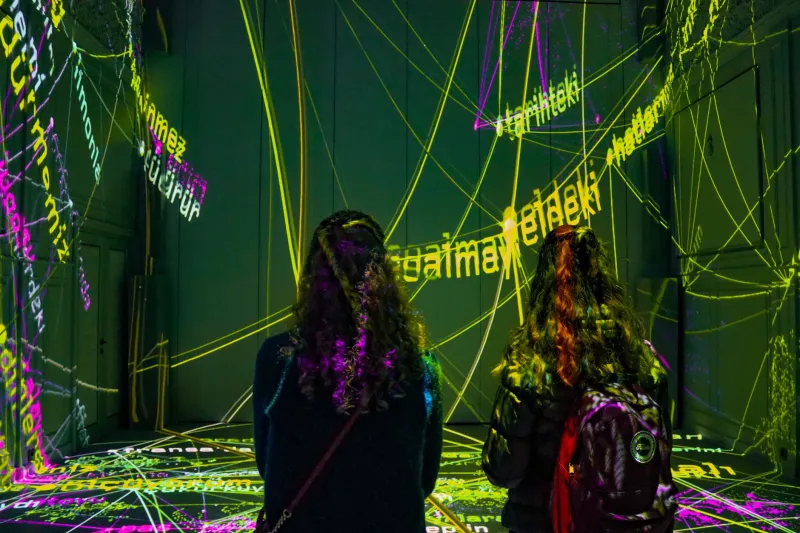
Here is a thing that happened at a gallery in Bushwick last fall: A visitor raised their phone to photograph an installation, and the installation — sensing the phone's proximity through a combination of ultrasonic detection and light-reactive materials — immediately and completely changed. The colors shifted. The sound component cut out. The physical arrangement of objects in the space rearranged, almost imperceptibly, into something flatter, less interesting, less itself. The photograph the visitor took was technically accurate and aesthetically nothing.
This was not a malfunction. This was the point.
Welcome to the anti-documentation movement — or as its participants prefer, the presence-first underground — a growing network of artists, collectives, and experimental designers who have decided that shareability is not a feature. It's the enemy.
The Unpostable Object
The logic starts with a simple observation: the photograph of an experience has replaced the experience itself. Not metaphorically. Actually. People move through galleries, concerts, and performances in documentation mode — selecting angles, adjusting filters, composing captions — while the thing they came to encounter recedes into soft focus behind the screen.
"We've trained ourselves to process experience as content," says Arlo Vásquez, one of the founding members of Null/Null, a New York-based collective that has been making aggressively undocumentable work since 2021. "And content is something you produce, distribute, and move on from. It's not something you have. We're interested in the having."
Null/Null's pieces are engineered at the design level to resist capture. Some use light sources that photograph as blank white. Others involve sound compositions that, when recorded on a phone microphone, produce only static — the frequencies are chosen to interact poorly with standard consumer audio compression. One piece consisted entirely of a scent that intensified when the room's ambient light dropped below a certain threshold, meaning that turning on a phone screen — even just to check notifications — made the smell disappear.
"We're not being difficult for the sake of it," Vásquez says. "We're asking: what is the work, actually? If the photograph captures everything that matters, then we failed. If the photograph captures nothing, then we're getting somewhere."
Presence as the Medium
Out in Los Angeles, collective Dead Air takes a different approach. Rather than building technical defenses against documentation, they design experiences that are simply, functionally impossible to explain to someone who wasn't there.
Their 2023 piece Overlap involved thirty participants seated in a dark room, each wearing headphones playing a different audio track. The tracks were composed so that they created a unified harmonic experience only when all thirty people were present — each individual's track was incomplete, sometimes dissonant, sometimes just strange. Together, the room produced something that participants describe as overwhelming and impossible to describe.
"We've had people try to record it," says Dead Air's Priya Nair. "They play back the recording and it's just noise. Because the piece isn't in the headphones. It's in the room. It's in the fact that thirty people are having thirty different experiences that somehow add up to one feeling. You can't bottle that."
Nair is thoughtful about the politics of this position. She's aware that "you had to be there" has historically been used to gatekeep cultural experiences, to make art exclusive and inaccessible. She pushes back on that reading.
"We're not saying you have to be rich or connected to get in the room," she says. "We're saying that getting in the room is the whole thing. Being there is not a prerequisite for consuming the content. Being there is the content. That's actually more democratic, not less."
The Platform Economy Problem
Understanding why this movement exists requires understanding what the artists are reacting against — which is, essentially, the complete absorption of cultural production into platform logic.
Social media platforms don't just distribute art. They shape it. The work that circulates most effectively is work that compresses well into a single image, generates immediate emotional response, and invites replication. Over time, artists — consciously or not — start making work that fits those parameters. The algorithm becomes a co-author.
"There's a feedback loop," says Vásquez. "Artists make shareable work, shareable work gets amplified, amplification makes that aesthetic dominant, other artists adopt it to compete. And slowly, the entire visual culture of a generation gets optimized for a 1080-pixel square. It's not a conspiracy. It's just gravity."
The anti-documentation movement is, among other things, an attempt to break that gravity. To make work that the platform cannot process, cannot distribute, cannot monetize — and therefore cannot colonize.
Dr. Simone Adler, a media theorist at the New School who has written about attention economics in the arts, sees this as significant. "When artists deliberately opt out of virality, they're not just making an aesthetic choice," she says. "They're making an economic argument. They're saying: the value of this work cannot be extracted from the experience of it. That's a direct challenge to how platform capitalism understands cultural value."
What Gets Lost, What Gets Found
There's a real cost to this approach. Work that can't be shared doesn't travel. It doesn't build the kind of cultural momentum that changes conversations, launches careers, or reaches people who couldn't get to the room. The anti-documentation artists are largely aware of this tradeoff and have made their peace with it — some more comfortably than others.
"I think about it," admits Nair. "I think about the person in rural Ohio who would love this work and will never encounter it because it doesn't exist online. That's a real thing. I don't have a clean answer."
What she has instead is a conviction that something important is being preserved. "There are experiences that change you," she says. "Not because they're intense or impressive, but because you were actually in them. Fully in them. No exit strategy, no documentation plan. Just you and the thing. I think we've almost forgotten what that feels like. We're just trying to remember."
Null/Null's next piece has no announced location. It will be communicated through word of mouth only. There will be no photographs. There will be, if they get it right, nothing to show anyone afterward — just a feeling you carry home in your body like a stone in your pocket, smooth and inexplicable and entirely, stubbornly yours.