No Hook, No Chorus, No Problem: Meet the Bedroom Producers Composing the Music of Unborn Dreams
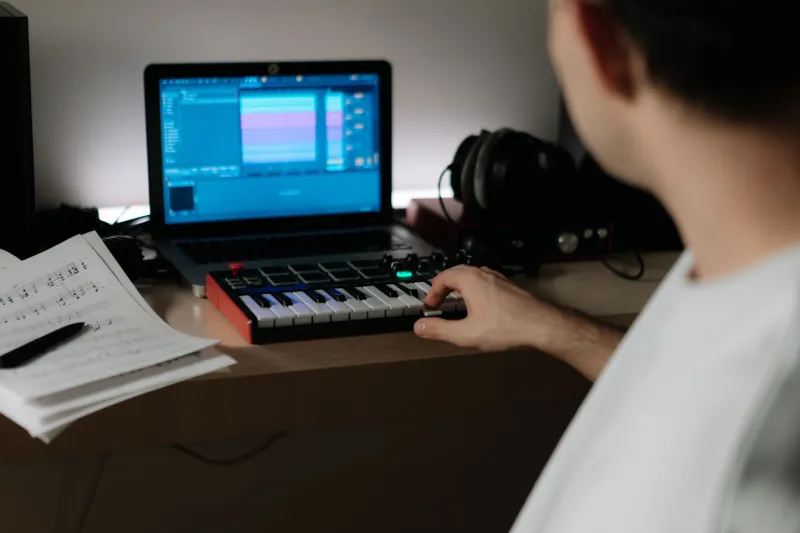
Somewhere in a studio apartment in East Nashville, a guy named Terrell has been awake for thirty-six hours watching a generative algorithm slowly mutate a four-second drone into something that sounds like a cathedral dissolving in slow motion. He hasn't touched a keyboard in twelve hours. He's just... watching. Listening. Occasionally nudging a parameter the way you'd nudge a sleeping dog to make sure it's still breathing.
Is it music? Is it finished? Terrell shrugs like those are the wrong questions entirely.
"Finished is a commercial concept," he says, not unkindly. "I'm not making a product. I'm making a weather system."
This is the underground. Not underground in the leather-jacket, VIP-basement sense — underground in the sense that it exists almost entirely outside the gravitational pull of the music industry's attention economy. And it is absolutely teeming with people doing some of the most genuinely strange, genuinely thrilling audio work happening in America right now.
The Collapse of the Song
For most of recorded music history, "a song" meant something pretty specific: a beginning, a structure, an ending. Even the most experimental artists — your Enos, your Laurie Andersons — were working in conversation with that architecture, even when they were deliberately blowing it up.
What's happening now feels categorically different. A growing cohort of producers — many of them working alone, many of them posting to niche Discord servers and Bandcamp pages with seventeen followers — are making music that doesn't have a structure to deconstruct in the first place. It simply... unfolds. Or doesn't. It accumulates. It breathes. It occasionally does something that sounds like a mistake and then keeps doing that mistake until the mistake becomes the point.
A lot of it is being made in collaboration with AI tools — not the kind of AI that generates a song from a text prompt and calls it creativity, but generative systems that introduce controlled unpredictability into a creative process. Think of it less like asking a robot to write your song and more like planting seeds in soil you've deliberately infected with something unknown.
Mara, a producer based in Portland who releases music under the name Peripheral Haze, uses a combination of custom Max/MSP patches and open-source machine learning models to generate melodic fragments that she then subjects to what she calls "environmental pressure" — feeding them through degraded hardware, analog tape machines running at the wrong speed, contact microphones taped to the outside of her apartment window.
"The AI gives me something that sounds almost intentional," she explains. "Then I run it through the world until it sounds almost accidental. Somewhere in between is where I live."
Algorithms as Collaborators, Not Employees
The conversation around AI and music has been dominated — exhaustingly — by anxiety. Will it replace musicians? Is it stealing? Can it be art? These are real questions, but they're also the wrong frame for understanding what artists like Mara and Terrell are actually doing.
For this community, generative AI isn't a replacement for human creativity. It's more like a collaborator with genuinely alien taste — one that doesn't know what a pop song is supposed to sound like, doesn't have a publishing deal to protect, and will cheerfully suggest something that no human producer would ever think to try because no human producer has ever been trained on the specific combination of data points that produced this particular suggestion.
"It surprises me," says DJ Quasar Moth — a Chicago-based producer who declined to share his legal name — "and I genuinely cannot surprise myself anymore. I've been making music for fifteen years. I know what I'm going to do before I do it. The algorithm doesn't know what it's going to do. That's the whole point."
This isn't laziness. If anything, working this way requires more active listening, more curatorial intelligence, more willingness to sit with something uncomfortable and ask whether the discomfort is the message. These producers are less composers in the traditional sense and more like — to borrow a metaphor from Terrell — storm chasers. They set up conditions and then follow what happens.
Lo-Fi as Philosophical Stance
A lot of this music is lo-fi, and not in the chill-beats-to-study-to sense that's been thoroughly commodified by YouTube playlists and Spotify algorithms. This is lo-fi as deliberate signal degradation, as refusal, as a kind of sonic humility that says: the artifact of the recording is part of the recording.
Tape hiss isn't cleaned up here — it's mixed in at exactly the level the producer wants. Clipping isn't avoided — it's invited, shaped, sometimes the entire texture of a track. The imperfection isn't aesthetic shorthand for "warm" or "vintage." It's a genuine philosophical commitment to the idea that perfection is a lie the industry tells you to sell you cleaner versions of the same thing.
In that sense, this scene has more in common with noise music and free jazz than it does with the bedroom pop it superficially resembles. The lo-fi aesthetic is a container for genuinely radical sonic ideas — it just happens to be a container that you can produce on a $400 laptop in your pajamas at 3 a.m.
The Question of 'Done'
Perhaps the most genuinely disorienting thing about this music is its relationship to completion. Many of these artists release work they explicitly describe as unfinished — not as a provocation, but as an honest description of the object.
Mara has released "versions" of the same piece across multiple years, each one a different snapshot of a living system that she's continued to modify. "I don't think of them as different songs," she says. "I think of them as photographs of the same river taken at different times of day."
This is a real challenge to the way we consume and categorize music, particularly in a streaming landscape built around discrete, stable, catalogued objects. You can't easily playlist a river. You can't really recommend a weather system. The algorithm — the commercial one, the one Spotify uses — doesn't have a good category for this stuff, which might be exactly why it's so interesting.
Why This Matters Beyond the Scene
It would be easy to file all of this under "niche experimental stuff that doesn't affect anything" and move on. That would be a mistake.
Every major shift in popular music — from blues to rock, from disco to hip-hop, from grunge to the PC Music hyperpop experiments of the 2010s — started in rooms like Terrell's. Started with people making things that had no commercial intent and no obvious audience and no clear category. The fact that this current wave is happening in collaboration with AI tools that are simultaneously becoming more accessible and more sophisticated means the timeline for cultural penetration might be shorter than anyone expects.
The sound of music that doesn't know it's supposed to have a hook is already bleeding into more mainstream contexts — in film scores, in video game soundscapes, in the ambient textures underneath podcast ads that you've heard a hundred times without consciously registering them.
The bedroom producers making dream-music for dreams you haven't had yet are, in some very real sense, composing the emotional atmosphere of whatever comes next. They're just doing it in the dark, without a label, watching an algorithm dissolve a cathedral, waiting to see what's underneath.
Terrell, for his part, is unbothered by the obscurity. He's uploaded three "versions" of his cathedral piece to a Bandcamp page with no bio and no photo. Combined streams: 214.
He seems genuinely thrilled about this.
"Two hundred and fourteen people heard something that doesn't exist yet," he says. "That's not nothing. That's everything."