Skin Deep: The Tactile Rebels Dragging You Back Into Your Own Body
Run your thumb across your phone screen right now. Go ahead. Notice anything? Probably not. That's the point.
You've touched that surface so many times that your nervous system has basically filed it under background noise — the same category as the hum of your refrigerator and the feeling of your own shirt collar. This is what neuroscientists call haptic desensitization, and it is, according to a loose but passionate coalition of artists working in fiber, metal, latex, clay, ice, and a few materials that don't have names yet, a full-blown crisis.
They're doing something about it. And it's going to feel weird.
Texture as Protest
The tactile art movement doesn't have a manifesto — at least not a written one. But spend enough time in its orbit and the thesis becomes clear: in a culture that has outsourced most of its sensory life to glass rectangles, the act of making someone genuinely, unavoidably feel something physical has become a radical gesture.
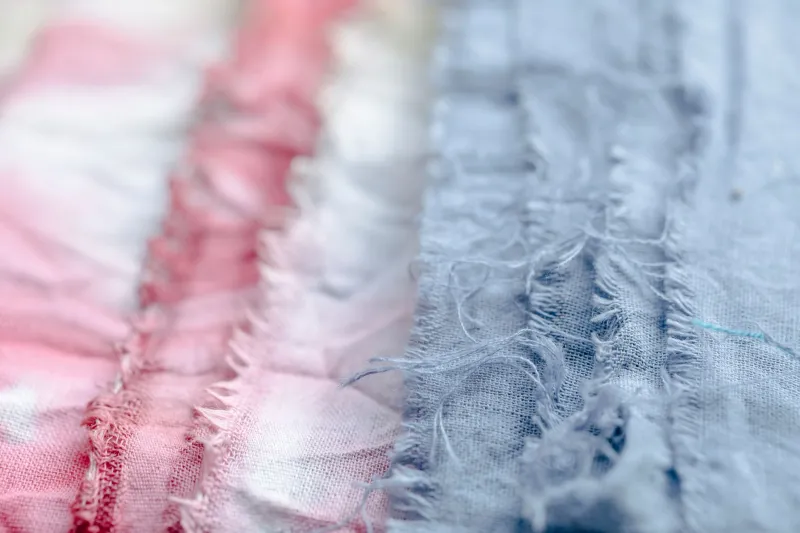
Chicago-based textile artist Dara Osei has been at the center of this shift for about six years. Her wearable sculptures — garments that are technically clothes but functionally closer to endurance events — are built from materials chosen specifically for their ability to provoke. Coarse sisal against bare skin. Velvet that runs in one direction only. Seams placed exactly where they'll catch on the body with every step.
"I'm not trying to hurt anyone," Osei says. "I'm trying to wake them up. There's a difference between pain and presence. I'm going for presence."
Her recent collection, Friction, was shown not on a runway but in a gallery where visitors were invited — encouraged, really — to touch every piece. Not just brush it with a fingertip. Hold it. Pull it. Feel what it does back. The response was almost universally the same: people laughed nervously, then went quiet, then stayed longer than they expected to.
"Touch makes time slow down," Osei says. "That's why people are scared of it."
The Temperature Artists
If Osei works in the register of texture, Brooklyn collective Cold Front operates in temperature — the most underexplored sensory territory in contemporary art, they'll tell you with the conviction of people who have thought about nothing else for years.
Their installations involve surfaces and objects held at specific thermal temperatures: not dangerously cold or hot, but precisely calibrated to sit just outside the range of comfortable neutrality. A metal chair that's a few degrees too cool. A fabric wall panel that's been warmed to just above body temperature, so that touching it feels vaguely, inexplicably alive.
"Temperature is the sense most connected to survival instinct," explains collective member Juno Reyes. "It's the one sense that still has a direct line to the part of your brain that decides whether you're safe. When we use it in an art context, we're essentially hot-wiring the nervous system."
One of their most talked-about pieces, 86 Degrees, involved a room maintained at a temperature that most visitors couldn't quite identify as too warm or too cool — it just felt subtly, persistently off. People couldn't focus on anything else. Their bodies kept trying to solve a problem that didn't have a solution. Several visitors reported feeling unusually emotional without knowing why.
"That's the sympathetic nervous system doing its thing," Reyes says. "We just gave it something to chew on."
Performance, Contact, and the Consent Question
The most provocative corner of the tactile movement involves direct human contact — performance art that puts the artist's body against the audience's in ways that are carefully negotiated but still genuinely confrontational.
Los Angeles-based performance artist Sable Knox creates what she calls "touch protocols" — structured one-on-one interactions in which participants consent in advance to a series of physical experiences: a hand pressed flat against a shoulder blade, a single finger drawn slowly along a forearm, the weight of someone else's palm resting on the back of the hand. Nothing that would read as intimate in any other context. But in the gallery, under fluorescent light, with full attention and no distraction, the effect is reportedly overwhelming.
"We don't touch each other anymore," Knox says flatly. "Not really. We hug people while we're already thinking about the next thing. I want to make touch an event again. Something you have to be present for."
The consent architecture around her work is meticulous — multilayered opt-ins, clear stop protocols, debrief conversations after. Knox is aware that she's operating in sensitive territory. But she pushes back against the idea that the discomfort her work generates is a problem.
"Discomfort is data," she says. "Your body is telling you something. Most of the time we just mute it because it's inconvenient. My work makes that harder to do."
Why Now
The timing of this movement is not a coincidence. The COVID years accelerated an already-existing drift away from physical contact and tactile engagement. The rise of remote work removed the incidental touches of shared physical space — the handshake, the shoulder tap, the accidental brush of hands reaching for the same door handle. And the devices got smoother, more uniform, more frictionless.
Osei sees the work she and her peers are doing as a direct response to that trajectory. "We made everything frictionless and then wondered why nothing feels like anything," she says. "Friction is how you know you're real. I'm giving that back."
Dr. Keisha Mbeki, a sensory neuroscientist at Northwestern, has been following the tactile art movement with professional interest. "The skin is the largest sensory organ in the body," she notes. "And it's the one we've most aggressively deprioritized in modern life. What these artists are doing — whether they know it or not — is essentially sensory rehabilitation. They're reminding the nervous system that it has a body."
The body, it turns out, is grateful. Even when it itches.